Garnier Whole Blends Honey Treasures: A Certified Formulator Reads Every Ingredient and Tells You Which Hair Types Actually Benefit
|
|
|
|
NAPPY CURLS | PRODUCT KNOWLEDGE
By Nappy Curls |
CPD-Certified Natural Haircare Formulator
You have probably seen the GarnierWhole Blends Honey Treasures line on the shelf at Walmart or Target. The gold
packaging catches your eye. The honey branding sounds promising. But should a
naturalista with 4C coils, gray transitioning hair, thinning edges, or a
sensitive scalp actually reach for it?
I pulled the full ingredient lists
for all three products in this line, the shampoo, the conditioner, and the rich
repairing mask, and I am going to break down every significant ingredient, tell
you what it does, how it interacts with specific hair types in our community,
and give you a straight verdict at the end.
No fluff. Just formulation
science.
What Is in This Line?
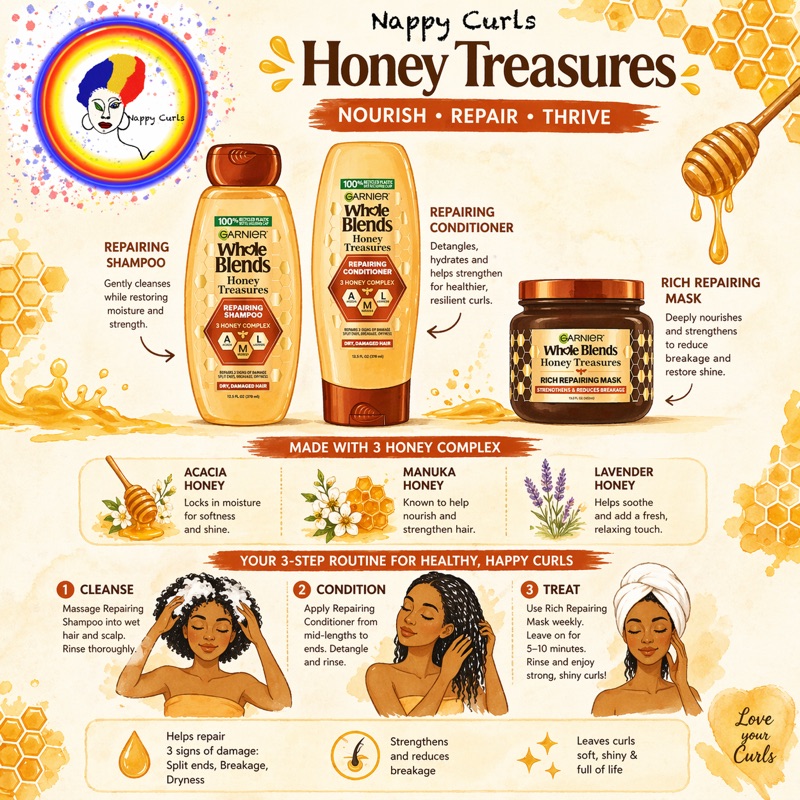
The Garnier Whole Blends HoneyTreasures system includes three products built around what Garnier calls a 3
Honey Complex: acacia honey, manuka honey, and lavender honey. The line is
marketed for dry and damaged hair and claims to repair split ends, reduce
breakage, and boost moisture. Let us see if the ingredients back that up.
The Shampoo: Ingredient by Ingredient
Shampoo ingredients in order of
concentration: Water, Sodium Laureth Sulfate, Sodium Lauryl Sulfate, Cocamide
MEA, Glycol Distearate, Sodium Chloride, Honey, PPG-5-Ceteth-20, Argan Oil
(Argania Spinosa Kernel Oil), Fumaric Acid, Royal Jelly, Carbomer, Glycerin,
Dimethicone, Aloe Vera, Sodium Hydroxide, Alcohol, Propolis Extract, Guar
Hydroxypropyltrimonium Chloride, Citric Acid, Sodium Benzoate, Salicylic Acid,
Yellow 5, Caramel, Fragrance, Coumarin, Limonene, Benzyl Alcohol, Benzyl
Salicylate.
Water
WHAT IT IS
The base of the formula and the
first ingredient, meaning it makes up the largest percentage of the product.
WHAT IT DOES
Water is the universal solvent
that carries all other ingredients and provides the primary hydration vehicle
in any rinse-off product.
Sodium
Laureth Sulfate and Sodium Lauryl Sulfate
WHAT THEY ARE
These are sulfate surfactants, the
primary cleansing agents in this shampoo. SLS and SLES are among the most
effective and most controversial ingredients in hair care.
WHAT THEY DO
They create lather and lift oil,
dirt, product buildup, and sebum from the scalp and hair shaft. They are
extremely effective cleansers.
WHAT THIS MEANS FOR YOUR HAIR TYPE
This is the most important thing
to know about this shampoo. Sulfates, particularly SLS, are powerful and can be
too stripping for hair types that already struggle with moisture retention. For
4C hair, which loses moisture faster than any other curl type due to its coil
geometry, a sulfate shampoo used frequently can create a cycle of dryness and
breakage. That said, sulfates are not universally bad. They are actually
necessary for deep clarifying, which every natural hair type needs periodically
to remove silicone and product buildup.
|
Formulator's
Note on Sulfates If you
have 4C, 4B, or any coily hair type, consider using this shampoo as a monthly
clarifying treatment rather than your regular wash day shampoo. Pair it with
the conditioner and mask immediately after to restore what the sulfates
stripped. Used this way, it becomes a valuable tool rather than a problem. |
Cocamide
MEA
WHAT IT IS
A coconut-derived foam booster and
viscosity agent.
WHAT IT DOES
It thickens the shampoo formula
and helps stabilize the lather created by the sulfates. It also has mild
conditioning properties.
WHAT THIS MEANS FOR YOUR HAIR TYPE
Generally well tolerated across
all hair types. It makes the product feel richer and more luxurious on
application.
Glycol
Distearate
WHAT IT IS
A pearlizing agent derived from
stearic acid.
WHAT IT DOES
It gives the shampoo its creamy,
pearlescent appearance and adds a slight conditioning effect to the lather.
WHAT THIS MEANS FOR YOUR HAIR TYPE
Cosmetic ingredient primarily. Low
risk and low impact on hair health across all types.
Mel
/ Honey
WHAT IT IS
Raw honey, one of nature's most
well-rounded hair care ingredients. This is the hero ingredient of the entire
Honey Treasures line.
WHAT IT DOES
Honey is a natural humectant,
meaning it draws moisture from the environment into the hair shaft. It also
contains natural sugars, amino acids, vitamins B and C, and antioxidants. It
has natural antibacterial and antifungal properties that benefit scalp health,
and its natural enzymes help break down product buildup gently.
WHAT THIS MEANS FOR YOUR HAIR TYPE
Honey is genuinely beneficial
across all curl patterns in our community. For 4C hair it helps attract and
hold moisture which is the primary challenge of the curl pattern. For gray
transitioning hair it adds softness and shine to strands that have lost their
natural moisture due to the absence of melanin. For thinning hair it supports a
healthy scalp environment which is the foundation of healthy regrowth. For low
porosity hair honey works best when applied with heat to help open the cuticle
and allow it to penetrate.
Argania
Spinosa Kernel Oil (Argan Oil)
WHAT IT IS
Pure argan oil, cold-pressed from
the kernels of the Moroccan argan tree. One of the most researched and
respected oils in natural hair care.
WHAT IT DOES
Argan oil is rich in oleic acid,
linoleic acid, and tocopherol (vitamin E). It penetrates the hair shaft,
reduces frizz, adds shine, and protects against heat and environmental damage.
It is lightweight enough that it does not weigh down even fine or low density
hair.
WHAT THIS MEANS FOR YOUR HAIR TYPE
Argan oil is one of the most
universally beneficial oils for natural hair. For 4C coils it helps smooth the
cuticle and reduce the surface area exposed to moisture loss. For gray hair it
restores the shine and softness that gray strands naturally lack. For thinning
hair it nourishes the scalp without clogging follicles. It is appropriate for
all porosity levels.
Royal
Jelly
WHAT IT IS
A substance secreted by honeybee
glands and fed exclusively to queen bees. It is packed with proteins, fatty
acids, vitamins B1 through B6, and amino acids.
WHAT IT DOES
Royal jelly strengthens the hair
shaft with protein support, stimulates hair growth by nourishing the follicle,
and has been studied for its ability to increase keratin production in the
hair. It also has anti-inflammatory properties that support a healthy scalp.
WHAT THIS MEANS FOR YOUR HAIR TYPE
This is one of the standout
ingredients in this formula for our target audience. For 4C hair experiencing
breakage, the protein content in royal jelly helps fill gaps in the cuticle and
reinforce weak points along the hair shaft. For gray hair, which loses protein
structure along with pigment, royal jelly helps restore some of that structural
integrity. For thinning hair and edges, the follicle-stimulating and
anti-inflammatory properties are directly relevant.
Glycerin
WHAT IT IS
A plant-derived humectant, one of
the most studied and most effective moisturizing ingredients in cosmetics.
WHAT IT DOES
Glycerin pulls water molecules
from the surrounding environment into the hair shaft. It is one of the most
effective moisture-attracting ingredients available.
WHAT THIS MEANS FOR YOUR HAIR TYPE
For 4C hair glycerin is extremely
beneficial in humid environments. In very low humidity environments it can draw
moisture out of the hair instead of the air. This is worth noting if you live
in a dry climate or use this product in winter months when indoor air is dry.
For all other hair types in our community glycerin is a net positive
ingredient.
Dimethicone
WHAT IT IS
A silicone, specifically a
non-water-soluble silicone that coats the hair shaft.
WHAT IT DOES
Dimethicone creates a smooth,
frizz-free finish and protects the hair from heat and humidity. It gives hair
that immediate silky feeling right after washing.
WHAT THIS MEANS FOR YOUR HAIR TYPE
This is where I want you to pay
attention. Dimethicone is not water soluble, meaning it cannot be removed by a
gentle or co-wash shampoo. It requires a sulfate shampoo to fully remove. If
you use this product and then switch to a sulfate-free shampoo, dimethicone
will build up on your hair over time, eventually blocking moisture from
entering the hair shaft and causing the very dryness you were trying to fix. If
you use this line, you need to clarify with a sulfate shampoo regularly to
prevent dimethicone buildup. Fortunately this line includes one.
Aloe
Barbadensis / Aloe Vera Leaf Juice
WHAT IT IS
Pure aloe vera, one of the most
gentle and effective natural hair care ingredients available.
WHAT IT DOES
Aloe vera soothes the scalp,
balances pH, provides lightweight hydration, and helps the hair retain moisture
without heaviness. It contains enzymes that gently promote healthy cell
turnover on the scalp.
WHAT THIS MEANS FOR YOUR HAIR TYPE
Aloe vera is beneficial across all
four of our target audiences. For sensitive or inflamed scalps it is
particularly soothing. For gray hair it adds moisture without the heaviness
that can make fine gray strands look limp.
Propolis
Extract
WHAT IT IS
A resinous mixture collected by
bees from tree buds and sap. It is one of the most powerful natural
antimicrobial substances known.
WHAT IT DOES
Propolis has strong antibacterial,
antifungal, and anti-inflammatory properties. It protects the scalp from
microbial overgrowth, reduces scalp inflammation, and supports a healthy
follicular environment.
WHAT THIS MEANS FOR YOUR HAIR TYPE
For anyone experiencing scalp
issues, dandruff, itching, or folliculitis this ingredient is a genuine asset.
For thinning hair and edges where the scalp environment directly affects
regrowth, propolis extract works to keep that environment clean and inflammation-free.
This is one of the most thoughtful inclusions in this formula.
Guar
Hydroxypropyltrimonium Chloride
WHAT IT IS
A modified guar gum, a natural
plant-derived conditioning agent.
WHAT IT DOES
It coats the hair shaft with a
positive charge that helps detangle, reduce static, and improve the slip of the
product. It also reduces friction during the wash process which directly
reduces mechanical breakage.
WHAT THIS MEANS FOR YOUR HAIR TYPE
For 4C hair this ingredient is
particularly valuable during the wash process. Detangling is one of the
highest-risk moments for mechanical breakage in coily hair. A conditioning
agent that reduces friction during washing is doing real protective work.
Salicylic
Acid
WHAT IT IS
A beta hydroxy acid derived from
willow bark. It is better known in skincare but has legitimate applications in
scalp care.
WHAT IT DOES
Salicylic acid is a gentle
exfoliant that dissolves dead skin cells and product buildup on the scalp. It
helps keep follicles clear and supports healthy cell turnover.
WHAT THIS MEANS FOR YOUR HAIR TYPE
For anyone with scalp buildup,
dandruff, or blocked follicles contributing to thinning or slow growth,
salicylic acid in a shampoo is directly beneficial. At the concentration used
in a rinse-off shampoo it is mild enough for most scalps.
Coumarin,
Limonene, Benzyl Alcohol, Benzyl Salicylate
WHAT THEY ARE
These are fragrance components,
specific aromatic chemicals that must be individually listed on labels in the
EU because they are known allergens.
WHAT THEY DO
They contribute to the scent
profile of the product. They serve no hair care function.
WHAT THIS MEANS FOR YOUR HAIR TYPE
If you have a sensitive scalp or a
history of contact dermatitis these are the ingredients most likely to cause a
reaction. Limonene in particular is a known sensitizer. In a rinse-off product
the risk is lower than in a leave-on product because the exposure time is
short. However if you have tried honey-scented products before and experienced
scalp irritation, fragrance components like these are likely the culprit.
The Conditioner: Ingredient by Ingredient
Conditioner ingredients: Water,
Cetearyl Alcohol, Behentrimonium Chloride, Amodimethicone, Honey, Argan Oil,
Potassium Hydroxide, Royal Jelly, Glycerin, Trideceth-6, Aloe Vera, Alcohol,
Propolis Extract, Isopropyl Alcohol, Citric Acid, Phenoxyethanol, Cetrimonium
Chloride, Benzoic Acid, Yellow 6, Yellow 5, Fragrance, Coumarin, Limonene,
Benzyl Alcohol, Benzyl Salicylate.
Cetearyl
Alcohol
WHAT IT IS
A fatty alcohol derived from
coconut or palm oil. Not to be confused with drying alcohols like ethanol.
WHAT IT DOES
Cetearyl alcohol is an emollient
and emulsifier that gives conditioners their creamy texture. It softens the
hair, improves slip, and helps other conditioning ingredients adhere to the
hair shaft.
WHAT THIS MEANS FOR YOUR HAIR TYPE
For 4C and 4B hair cetearyl
alcohol is a very beneficial ingredient. It helps the conditioner spread
through dense coils and provides meaningful softness. For gray hair which tends
to be coarser and drier it adds the slip and softness the strands need. Universally
positive across all our target hair types.
Behentrimonium
Chloride
WHAT IT IS
A quaternary ammonium compound,
one of the most effective and gentle conditioning agents used in professional
hair care.
WHAT IT DOES
It carries a positive electrical
charge that is attracted to the negative charge of damaged hair. It deposits
directly on the areas that need it most, particularly along the cuticle, and
dramatically reduces static, tangling, and friction. It is significantly
gentler than older quaternary ammonium compounds like cetrimonium chloride.
WHAT THIS MEANS FOR YOUR HAIR TYPE
This is one of the best
conditioning agents available for 4C and coily hair. The detangling and
friction-reducing properties are directly relevant to the mechanical breakage
challenge that coily hair faces. For thinning edges behentrimonium chloride
helps detangle gently without the tension that causes additional breakage. A
standout ingredient in this conditioner.
Amodimethicone
WHAT IT IS
An amino-functional silicone.
Unlike regular dimethicone, amodimethicone is actually recommended by many
natural hair formulators because of how selectively it deposits on the hair.
WHAT IT DOES
Amodimethicone has a positive
charge that causes it to deposit preferentially on the most damaged parts of
the hair shaft, exactly where silicone protection is most needed. It
dramatically smooths the cuticle, reduces frizz, and adds a protective coating
that helps prevent further damage. It also rinses more easily than
non-functional silicones.
WHAT THIS MEANS FOR YOUR HAIR TYPE
For 4C hair that has experienced
heat damage, color damage, or mechanical breakage, amodimethicone is genuinely
beneficial and not the problematic silicone that non-natural conditioners
typically use. For gray hair that has lost its natural protective lipid layer,
amodimethicone provides a substitute protective coating that restores shine and
manageability. This is one of the most well-placed ingredients in the
conditioner formula.
Potassium
Hydroxide
WHAT IT IS
An alkaline compound used to
adjust the pH of the formula.
WHAT IT DOES
It balances the pH of the
conditioner to ensure it is appropriate for the hair and scalp. Without pH
balancers, formulas can be too acidic or too alkaline and cause damage to the
cuticle.
WHAT THIS MEANS FOR YOUR HAIR TYPE
This is a functional ingredient,
not an active one. Its inclusion tells you Garnier is paying attention to
formula pH which is a good sign for overall product quality. A properly
pH-balanced conditioner closes the hair cuticle after washing and locks in moisture.
Trideceth-6
WHAT IT IS
A surfactant and emulsifier that
helps water-based and oil-based ingredients mix together and helps rinse-out
products wash away cleanly.
WHAT IT DOES
It helps the amodimethicone
deposit evenly on the hair rather than clumping, and ensures the conditioner
rinses cleanly without leaving heavy residue.
WHAT THIS MEANS FOR YOUR HAIR TYPE
A functional ingredient that
improves the performance of other ingredients. Low risk across all hair types.
The Rich Repairing Mask: Ingredient by Ingredient
Hair Mask ingredients: Water,
Cetearyl Alcohol, Behentrimonium Chloride, Amodimethicone, Candelilla Wax,
Cetyl Esters, Glycerin, Honey, Argan Oil, Royal Jelly, Trideceth-6, Aloe Vera,
Alcohol, Propolis Extract, Isopropyl Alcohol, Hydroxypropyl Guar, Citric Acid,
Phenoxyethanol, Chlorhexidine Dihydrochloride, Cetrimonium Chloride, Yellow 6,
Yellow 5, Fragrance, Coumarin, Limonene, Benzyl Alcohol, Benzyl Salicylate.
Candelilla
Wax
WHAT IT IS
A plant-based wax derived from the
candelilla shrub native to Mexico. It is a vegan alternative to beeswax.
WHAT IT DOES
Candelilla wax seals the hair
cuticle, adds shine, and creates a protective film over the hair shaft that
slows moisture evaporation. It is firmer than most oils and butters which makes
it effective at filling in gaps along damaged cuticle edges.
WHAT THIS MEANS FOR YOUR HAIR TYPE
For 4C high porosity hair where
the cuticle is permanently raised or damaged, candelilla wax provides a sealing
action that oils and conditioners alone cannot achieve. For gray hair that has
lost its natural cuticle lipid protection, wax provides a substitute barrier.
This is an excellent inclusion in a repair mask and one that distinguishes it
from a basic conditioner.
Cetyl
Esters
WHAT IT IS
A synthetic wax made from fatty
acid esters. It mimics the feel and performance of spermaceti, a natural wax
once used in luxury cosmetics.
WHAT IT DOES
Cetyl esters add richness and slip
to the mask, improve its spreadability through thick or dense hair, and provide
a lightweight emollient coating on the hair shaft.
WHAT THIS MEANS FOR YOUR HAIR TYPE
For 4C and 4B hair where density
and coil tightness can make product distribution challenging, cetyl esters help
the mask spread evenly through all sections. A practical and well-chosen
ingredient for a mask targeting coily and damaged hair.
Chlorhexidine
Dihydrochloride
WHAT IT IS
A broad-spectrum antimicrobial
agent used in medical and cosmetic applications.
WHAT IT DOES
It prevents microbial growth in
the product formula and on the scalp. It is more powerful than most cosmetic
preservatives and has lasting antimicrobial action even after rinsing.
WHAT THIS MEANS FOR YOUR HAIR TYPE
For anyone with a sensitive or
inflamed scalp, scalp conditions, or folliculitis-related hair thinning,
chlorhexidine in a mask provides meaningful antimicrobial scalp support. It is
a more aggressive ingredient than typical cosmetic preservatives. At the
concentration used in a rinse-off mask it is appropriate for most scalp types
but those with very sensitive skin should monitor for any reaction.
The Verdict: Which Hair Types Benefit Most?
Based on the full ingredient
analysis of all three products, here is my honest formulator's assessment by
hair type and concern:
|
HAIR
TYPE |
HOW IT
WORKS FOR YOU |
VERDICT |
|
4C
Coils |
Honey and
glycerin attract moisture. Behentrimonium chloride and amodimethicone reduce
breakage during detangling. Use shampoo monthly for clarifying only.
Conditioner and mask are your workhorses. |
YES
with strategy |
|
4B
Coils |
Same
benefits as 4C. The mask's candelilla wax is especially helpful for sealing
moisture into tightly coiled strands. Avoid daily sulfate use. |
YES
with strategy |
|
3C and
4A |
All three
products work well. The conditioning system is rich enough for coily patterns
without being too heavy for the looser curl definition of 3C. |
YES |
|
3B
Curls |
The
conditioner and mask work beautifully. The shampoo may be too stripping for
regular use on 3B curls. Use a gentler shampoo and reach for this one
monthly. |
YES
for mask and conditioner |
|
Gray
Transitioning Hair |
Royal
jelly, honey, argan oil, and amodimethicone directly address the dryness,
coarseness, and loss of shine that come with the gray transition. This line
is a genuinely strong option. |
STRONG
YES |
|
Thinning
Hair and Edges |
Propolis,
royal jelly, salicylic acid, and honey create a healthy scalp environment
that supports regrowth. Avoid applying the mask directly to thinning edges
under heavy tension. |
YES
for scalp health |
|
High
Porosity Hair |
The
candelilla wax and amodimethicone in the mask are designed for this. They
seal the open cuticle and slow moisture loss. This line was essentially
formulated with high porosity in mind. |
STRONG
YES |
|
Low
Porosity Hair |
The
sulfate shampoo can actually help remove buildup that blocks moisture in low
porosity hair. Use the mask with heat for deeper penetration. Lighter
application to avoid buildup. |
YES
with heat |
|
Sensitive
Scalp |
The
fragrance components, coumarin, limonene, benzyl alcohol, may cause
irritation. Patch test first. The actives are good but the fragrance load is
a risk factor. |
CAUTION |
The Formulator's Overall Take
The Garnier Whole Blends Honey
Treasures line is a genuinely solid drugstore option for curly, coily, and
natural hair. The honey, royal jelly, propolis, argan oil, behentrimonium
chloride, and amodimethicone are all ingredients I would choose in a formula I
was building myself. The conditioner and mask in particular are well
constructed for the damaged and coily hair market they are targeting.
The shampoo is the weakest link
because of the sulfate base. It is not a bad shampoo. It is a clarifying
shampoo that should be used as one: periodically, not routinely.
The fragrance load is my other
note of caution. Several of the fragrance components are known allergens. For
scalps that are already sensitive or compromised, that is a consideration worth
tracking.
Overall verdict: the conditioner
and mask are worth your money. The shampoo belongs in your monthly clarifying
rotation, not your weekly wash day.
|
Want
Me to Read Your Products? If you
have a product you are using or thinking about buying and you want a
certified formulator to break down every ingredient and tell you whether it
is right for your specific hair type, fill out the contact form on our
website at nappycurlshair.com. Tell
me the product. I will tell you the truth about what is in it. Or book
The Crown Assessment for a complete custom routine built around your hair
type, porosity, and goals by a CPD-Certified Natural Haircare Formulator. nappycurlshair.com |
|
|
|
|


Comments
Post a Comment